ECD Digital Strategy builds an AI-ready warehouse and asks it questions
Unite brings six ad platforms and 10+ client accounts into one BigQuery warehouse. Claude answers questions against it in plain English, and written metric and schema definitions keep the numbers consistent every time.



COMPANY SIZE
REGION
INDUSTRY
TOPICS
Key results
- Unified six ad platforms across 10+ client accounts into a single BigQuery dataset, refreshed daily.
- Built a 40+ table warehouse with history back to January 2025 and no manual exports anywhere in the chain.
- The recurring weekly client report is now drafted from a single prompt, with unverifiable fields flagged rather than filled in.
- Weekly report prep for a client down from around four hours to around one.
"Monday used to start with six logins and a spreadsheet before I could tell a client anything. Now I ask for the week and read what comes back. The time saved is the obvious part, but what I notice more is that I ask follow-up questions I would previously have let go."
— Florencia Zanetic, Paid Media & Social Ads Specialist, ECD Digital Strategy
ECD Digital Strategy is a US based paid-media agency managing multiple ecommerce and direct-to-consumer brands across gardening and outdoor products, industrial equipment, specialty food and consumer goods.
Unlike a single-brand in-house team, ECD shoulders every client's complexity at once. Each brand runs a different channel mix, and each platform describes the same business event in its own dialect: Meta separates link clicks from all clicks, Google and TikTok store money in different units, Vibe has no clicks at all because nobody clicks a television, and Pinterest counts conversions on its own attribution window. Reconciling all of it fell to the account leads, ahead of every Monday call.
Every recurring report was assembled by hand: six logins, six exports, six definitions of the same word, pasted into a document. It was slow and fragile because a rushed export with the wrong date range produces a number that looks exactly like a correct one. And since assembling a number was expensive, the interesting follow-up question usually went unasked.
That unasked question is the real cost, and a dashboard does not fix it. A dashboard answers what someone thought to ask when it was built, so anything new waits for a ticket. ECD wanted the opposite: an account lead able to chase a hunch on a Tuesday and act proactively on it before the client asks about it on Monday.
The rebuild centred on three priorities:
- Land every platform in one warehouse on a schedule, with no manual step in the chain.
- Make the warehouse safe to query conversationally, so that cost and correctness both hold as the questions multiply.
- Write down what the data means, so answers are defensible rather than merely fast.
Standardising on a modern stack: Unite, BigQuery and Claude
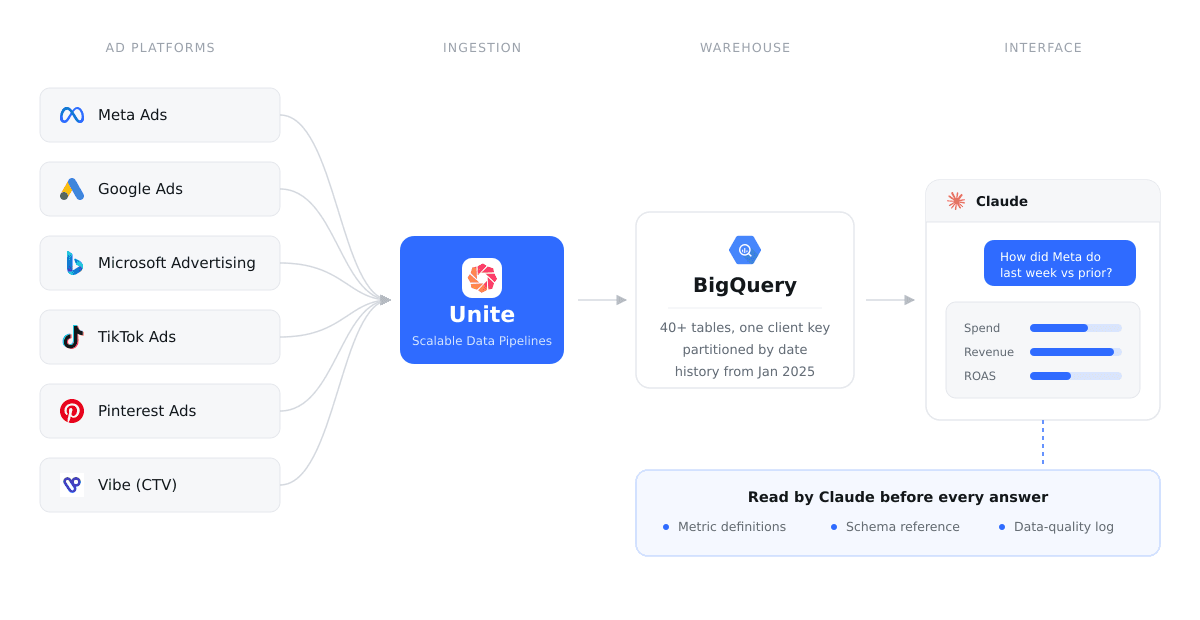
Unite became the foundation for data movement. It connects each client’s ad platform and syncs it into ECD's BigQuery data warehouse daily, absorbing the work that makes in-house pipelines expensive to own: pagination, rate limits, token refreshes, and the schema changes that arrive when a platform quietly renames a field.
Two build decisions did most of the heavy lifting.
Fields are standardised as the data lands, not at query time. Date and campaign fields are normalised on the way in, so platforms behave consistently downstream. The alternative is patching the same differences inside every query, forever.
And because one warehouse serves every account, every row carries a stable client key, which is also the clustering key. Scoping a question to one brand is a filter rather than a separate dataset, and that same filter prunes what BigQuery scans. Combined with date partitioning, this is what keeps an exploratory conversation from becoming an expensive one.
Landing the data is only half of it. Statfinity, the team that built Unite, wrote the necessary SQL models that turn what each platform sends into tables the agency can actually report on. BigQuery holds the result: 40+ tables covering campaign, ad, creative, keyword, audience, budget and status data, with history back to January 2025 and yesterday's numbers available this morning.
Claude, connected through the official BigQuery MCP connector, is the interface. It reads the schema, writes the SQL, runs it and explains the answer in plain language, with the query visible, so a wrong join can be caught before it reaches a client deck. Setting that up is an OAuth client, three IAM roles and a consent screen. The full procedure can be read here: How to Ask Claude Questions About Your BigQuery Data.
Teaching Claude to speak the agency's language
A connector tells the model what exists. It cannot tell the model what matters, and that gap is where wrong answers come from, because they arrive looking exactly like right ones. Statfinity closed the gap by writing ECD's institutional knowledge into three reference files the model reads before every answer.
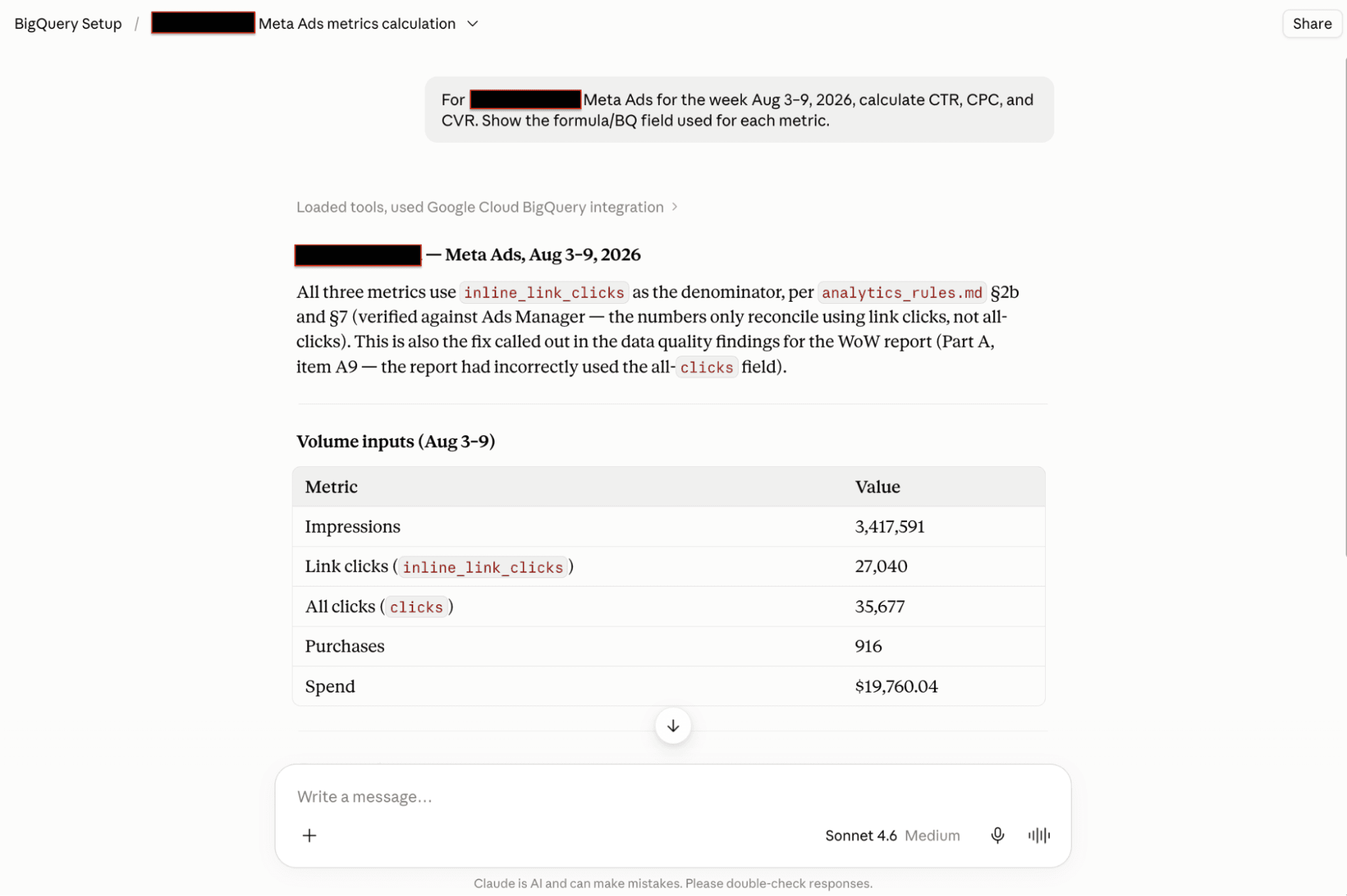
Metric definitions settle the ambiguities no schema can. Which column is revenue on each platform. Meta's click-through and cost-per-click are calculated on link clicks, not all clicks, a distinction that silently moves every efficiency figure in a report. Vibe's CTV numbers are view-through attributes and cannot be ranked on return on ad spend against paid search. And when a rate metric genuinely does not apply to one channel, the nearest valid equivalent is substituted and labelled, rather than the channel being quietly dropped from an "all platforms" answer.
A schema reference describes all 40+ tables in plain language: what each table is one row of, which one is authoritative for an account total versus a creative breakdown, and which pairs must never be combined because they cover the same spend at two different grains.
A data-quality log records what is known to be unreliable right now and the rule that follows from it. Most teams never write this file. It is the one that stops a broken number reaching a client, because it is checked before anything is reported.
Above all of it sit two standing rules: every query is scoped to a single client, and if the question does not make clear which client, the answer is a question rather than a guess.
“It tells me when something is missing instead of filling the gap with something plausible. That sounds like a small thing, but it is the reason I am comfortable sending out what it drafts.”
— Florencia Zanetic, Paid Media & Social Ads Specialist, ECD Digital Strategy
Driving measurable impact on Monday morning
The clearest test is ECD's weekly client report: current week versus prior, per platform and per campaign, with spend, revenue and return on ad spend.
It used to be built by hand from six exports. It now starts as a prompt naming the client and the week. The model confirms the account, checks how fresh each platform's data is, clamps the comparison to a window every channel covers, checks the data-quality log for anything affecting that client or week, and drafts the report.
What it will not do is invent. Anything the warehouse cannot ground, such as a manual budget change or the reason behind a spike, comes back as a visible placeholder for the account lead to fill. A gap you can see beats a confident sentence nobody checked.
A foundation that is ready for what comes next
The rebuild was never only about faster reporting. Centralising and standardising data movement produced something more durable: a governed warehouse that AI tooling can be pointed at safely.
That distinction is doing more work than it appears. An AI assistant on top of fragmented exports produces fluent guesses. The same assistant on top of a scheduled, standardised warehouse with written definitions produces numbers an account lead can take into a client meeting. The ingestion layer is what decides which of the two you get.
"We built this for reporting, and reporting is now the least interesting thing it does. Questions we used to postpone because they were not worth the export are a two-minute conversation, and that changes what we can offer clients."
— Emil Gjorgjijev, E-Commerce Operations Manager, ECD Digital Strategy
Unite moves data from over 100 sources into BigQuery on the schedule you set, with field standardisation as the data lands and failure alerts so the answers stay current. Pricing is based on users, sources and pipelines rather than rows, so an exploratory conversation that scans a lot of data does not change what your pipeline costs.
Start your free 15-day trial and get your marketing, sales and commerce data into BigQuery.
Need someone to run the campaigns too? ECD Digital Strategy does paid social and paid media management for ecommerce and DTC brands.
If it is the warehouse itself you would rather not build, Statfinity, the team behind Unite, builds BigQuery warehouses for ecommerce and marketing teams across the US, EU and India, connecting the sources, modelling the tables, writing the metric definitions and wiring up the connector at the end. Tell us what you are trying to measure and we will tell you what it takes.
LET’S BUILD SMARTER DATA PIPELINES — TOGETHER.
Whether you're migrating from another ETL platform or starting fresh, Unite helps your team launch reliable data pipelines fast. Need a demo, drop us a message below: