A DTC growth agency builds an AI-ready data warehouse
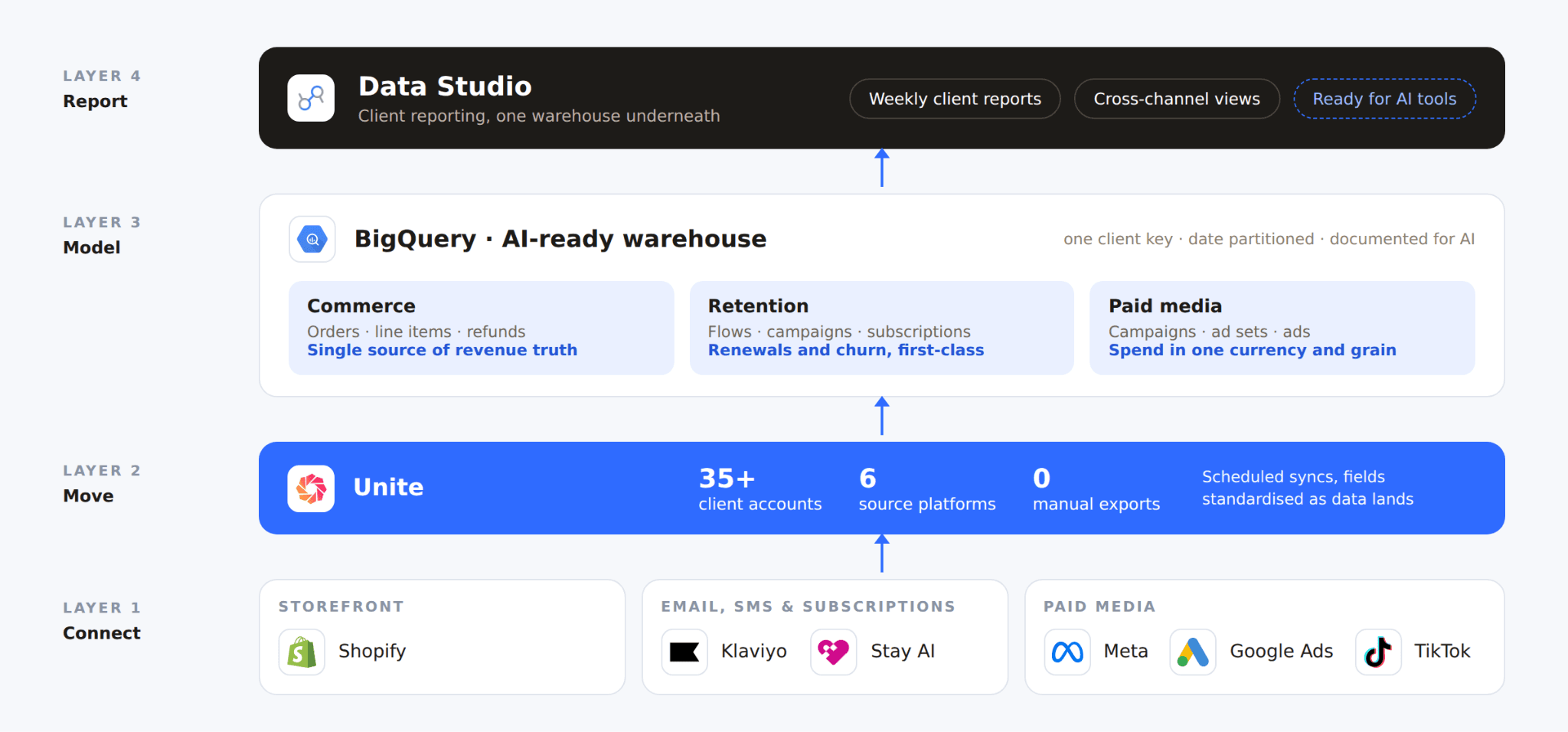
Unite brings Shopify, Klaviyo, Stay AI, Meta Ads, Google Ads and TikTok Ads into one BigQuery warehouse. Modelled tables feed the agency's Data Studio reporting today, and are structured so AI tools can query them next.


COMPANY SIZE
REGION
INDUSTRY
TOPICS
Key results
- Unified six sources across 35+ client accounts into a single BigQuery warehouse, with no manual exports anywhere in the chain.
- Built an AI-ready warehouse with history back to January 2024, modelling commerce, retention and paid media side by side and keying every row to its client.
- Moved Data Studio reporting onto modelled BigQuery tables instead of separate platform connectors.
- Documented the warehouse so AI tools can be pointed at it safely when the agency is ready.
The client is a US-based growth marketing agency that runs paid media, retention, creative and ecommerce for consumer and direct-to-consumer brands, across more than 35 client accounts. It is not named in this case study.
Running every growth channel for a brand means living with every system's version of the truth. Shopify records the order. Klaviyo attributes part of that order's revenue to the email that came before it. Meta, Google and TikTok each claim it too, on their own attribution windows. And Stay AI knows whether the customer went on to subscribe, skip or cancel. Multiply that by 35+ client accounts and the same question, what drove revenue last week, has a different answer depending on which dashboard is open.
In reporting, that fragmentation turns into fragile dashboards. A Data Studio report wired straight to six platforms inherits six sets of field names, six refresh behaviours and six definitions of revenue, and the logic that reconciles them ends up scattered across calculated fields in individual reports, where it is hard to check and easy to break.
The agency also wanted its data ready for AI. An assistant pointed at dashboards or exports can only produce fluent guesses. Pointed at a governed warehouse with written definitions, it can produce numbers a strategist can use. Building the warehouse properly once serves both needs.
The build centred on three priorities:
- Land every source in one warehouse on a schedule, for every client, with no manual step in the chain.
- Model once, report everywhere, so business logic lives in the warehouse rather than inside each dashboard.
- Make the warehouse AI-ready, so any tool that reads it, today or later, reads data whose meaning is written down.
Standardising on a modern stack: Unite, BigQuery and Data Studio
Unite became the foundation for data movement. It connects each client's Shopify store, Klaviyo account, Stay AI subscriptions and Meta, Google and TikTok ad accounts, and syncs them into the agency's BigQuery data warehouse on a schedule. It absorbs the work that makes in-house pipelines expensive to own: pagination, rate limits, token refreshes, API version changes, and the schema changes that arrive when a platform quietly renames a field. Across 35+ accounts and six sources, that maintenance burden multiplies quickly, and Unite carries it.
Two build decisions did most of the heavy lifting.
Fields are standardised as the data lands, not at query time. Dates, currencies and campaign fields are normalised on the way in, so an ad platform's spend, a Klaviyo flow's attributed revenue and a Shopify order total can sit in the same query without each difference being patched by hand, forever.
And because one warehouse serves every client, every row carries a stable client key, which is also the clustering key. Scoping a report to one brand is a filter rather than a separate dataset, and that same filter prunes what BigQuery scans. Combined with date partitioning, this keeps dashboards responsive and query costs predictable as reports multiply.
Landing the data is only half of it. Statfinity, the team that built Unite, wrote the SQL models that turn what each source sends into reporting-ready tables: orders, line items and refunds from Shopify; campaigns, flows and attributed revenue from Klaviyo; subscription status, renewals and cancellations from Stay AI; and campaign, ad set and ad performance from Meta, Google and TikTok, with history back to January 2024.
Data Studio sits on top. Each client dashboard connects to BigQuery tables that already agree on dates, currency and client, so a report becomes a view of the warehouse rather than the place where numbers get reconciled.
What makes the warehouse AI-ready
A data connection tells an AI model what exists. It cannot tell the model what matters, and that gap is where confident wrong answers come from. An AI-ready warehouse closes the gap in the data layer itself, before any question is asked. The same work makes dashboards more trustworthy today.
Revenue has one source of truth. Shopify is the system of record for what was sold. Klaviyo and the ad platforms each report attributed revenue, and those figures overlap by design, so they are modelled as attribution views and never summed into a total. Blended efficiency, such as the marketing efficiency ratio, is calculated from Shopify revenue against total spend across every channel.
Every table states its grain. Each model is documented in plain language: what one row represents, which table is authoritative for an account total versus a campaign or creative breakdown, and which pairs must never be joined because they describe the same spend at two different levels.
Subscriptions are first-class data. Stay AI's records sit alongside Shopify orders, so a first purchase, a renewal and a cancellation are distinguishable in any report or query.
And because every row carries a client key, any tool, a dashboard today or an AI assistant later, can be scoped to a single client with one filter. With 35+ brands in one warehouse, a number from the wrong account is worse than no number at all.
Driving measurable impact on client reporting
The clearest test is the weekly client report: current week versus prior, with paid spend by channel, Shopify revenue, email and SMS contribution from Klaviyo, and subscriber movement from Stay AI.
In Data Studio, that report reads from one warehouse rather than a connector per platform. When a definition changes, it changes once in BigQuery and every dashboard built on it picks the change up. The same report works the same way for every one of the 35+ accounts, so a strategist can check a client's numbers before the meeting instead of assembling them for it.
Because the models are shared across clients, a new account lands in the same tables as every other one, ready for the same reports on day one.
A foundation that is ready for what comes next
The project was never only about reporting. By centralising and standardising data movement, Unite laid something more durable: a governed warehouse that serves Data Studio today and can be handed to AI tools when the agency is ready.
That distinction is doing more work than it might appear. AI on top of fragmented exports produces fluent guesses. The same AI on top of a scheduled, standardised warehouse with documented definitions produces numbers a strategist can take into a client meeting. The ingestion layer is what decides which of the two you get, and here that layer is Unite.
Unite moves data from over 100 sources into BigQuery on the schedule you set, with field standardisation as the data lands and failure alerts so reports stay current. Pricing is based on users, sources and pipelines rather than rows, so dashboards that refresh often, or AI tools that query heavily, do not change what your pipeline costs.
Start your free 15-day trial and get your marketing, sales and commerce data into BigQuery.
If it is the warehouse itself you would rather not build, Statfinity, the team behind Unite, builds AI-ready BigQuery warehouses for ecommerce brands and agencies across the US, EU and India, connecting the sources, modelling the tables, documenting the definitions and wiring up the reporting and AI tools your team uses. Tell us what you are trying to measure and we will tell you what it takes.
LET’S BUILD SMARTER DATA PIPELINES — TOGETHER.
Whether you're migrating from another ETL platform or starting fresh, Unite helps your team launch reliable data pipelines fast. Need a demo, drop us a message below:
